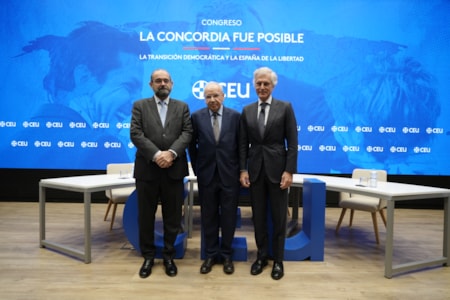
Former Spanish Deputy Prime Minister (1982–1991) Alfonso Guerra delivered the inaugural lecture at the congress “Concord Was Possible: The Democratic Transition and the Spain of Freedom”, an event organised by the CEU Institute of Democracy Studies and the CEU Institute of Historical Studies to reflect on one of the most decisive periods in of modern Spanish history.
Under the title “Memory, Remembrance and the Legacy of the Transition”, Guerra highlighted how, during the Transition, political parties looked towards a civic-minded Spain built on tolerance. “The parties changed their approach, focused on restoring concord, coexistence and democracy”, he emphasised. For this reason, he argued that the spirit of 1978 must guide today’s political leaders: “Consensus was the path that led us to concord. It was the sum of the sacrifices we all had to make in order to reach agreement”. He called on the country’s two “major parties,” the PP and the PSOE, to rediscover that approach.
Guerra stressed that “we cannot choose the era in which we live, but we can choose how we respond to it”. He recalled how “an entire generation agreed that all politicians had to reach an understanding”. He also underscored the value of the 1978 Constitution, saying, “I am not in favour of its reform, but of specific reforms within its framework”. He described the Constitution as “a peace charter, an armistice created with the aim of cooperation,” lamenting that “today we see how the Public Administrations have failed to cooperate in crises such as COVID, flooding, blackouts and wildfires”.
Reflecting on the challenges faced during the search for consensus, Guerra mentioned debates such as the need to repeal the Constitution of 1931 in order to draft new texts that “guaranteed a democratic system and political alternation”; the decision to establish a secular or non-confessional State; and the choice between monarchy or republic as Spain’s form of government.
Adolfo Suárez Illana, Member of Parliament from 2019 to 2022, who introduced Guerra’s address, cited his father’s words: “Nothing is definitively lost or won; it depends on the boldness we put into our endeavours.” He described the Transition as “a political and social process of understanding the ‘other’ Spaniard, the one who does not think like me, who does not share my religious ideas, who was not born in my region, who is not driven by my political ideals. He is not my enemy, but my counterpart as a citizen and as a Spaniard. Only through coexistence can we defend our ideals, practise our beliefs and shape our own ideas”.
The President of the CEU San Pablo University Foundation, Alfonso Bullón de Mendoza, opened the event by thanking the protagonists of the Transition for their contribution, describing it as “the most significant political achievement of our contemporary era, a period marked by concord”.
From the 1.001 Trial to the Commission of the Nine
Economist and former politician Ramón Tamames took part in a round table entitled “From the 1,001 Trial to the Commission of the Nine”, alongside Soledad Becerril, Minister of Culture from 1981 to 1982, and journalist Fernando Jáuregui.
“These are historical matters that cannot be resolved by a Ministry of Democratic Memory, which is essentially a Stalinist method of teaching history. I did not come to deliver a political rally, but we are practically living in one. If we continue like this, historical memory will end up telling us that Sánchez invented Social Security and national unity”. Tamames spoke sharply in response to a question about when this historical period began, noting that some argue it predates 1975.
Becerril affirmed that the Transition “was not a rupture, as part of the left demanded, but rather a reform so deep that it eventually became a rupture”. She highlighted the role of King Juan Carlos I, who played “a crucial part” in the failure of the attempted coup of 23 February 1981. She also referred to the recent ceremony in Parliament marking the 50th anniversary of the King’s proclamation, recalling historian Juan Pablo Fusi’s words that “the reform was a work of craftsmanship”. “King Juan Carlos conferred democratic legitimacy on the democratic opposition and later on the establishment of democracy,” she concluded.
Jáuregui also referred to this anniversary and to the emphasis placed by historians present at the event on concord, agreement and consensus,“the very spirit that was conspicuously absent from the ceremony, for if anything defines Spanish politics today, it is a brawl with cudgels”.
Transition, Spain and Concord
The congress forms part of the initiative “Transition, Spain and Concord”, with which CEU Universities have joined the commemoration of the fiftieth anniversary of the proclamation of King Juan Carlos I. The initiative began with the awarding of honorary doctorates to José Manuel Otero Novas (CEU Cardenal Herrera University), Miquel Roca (CEU Abat Oliba University), Marcelino Oreja and Her Majesty Queen Sofía (CEU San Pablo University). It has also included the summer course “Spain and the Monarchy”, a travelling exhibition curated by professors Cristina Barreiro and Álvaro de Diego based on archival photographs from Ya and Diario 16; and the documentary “Memory of the Transition: Half a Century of Democracy".