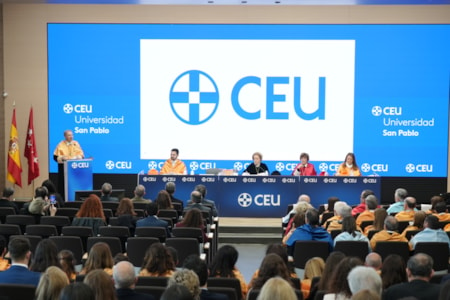
The Faculty of Economics and Business has celebrated the feast of its patron saint, St. Vincent Ferrer, with an academic ceremony in which awards were presented in various categories to faculty members and students, as well as to partner companies and institutions for their strong ties and commitment to the Faculty and its students.
The event was inaugurated by the Dean, Ricardo Palomo, who highlighted the value of the people who make up the Faculty and expressed his gratitude for the collective effort of faculty, staff, and students. In a context marked by economic uncertainty, technological advances, and geopolitical challenges, he emphasized the responsibility to “educate professionals who are rigorous and who have values and critical thinking skills.” In his speech, Palomo underlined the Faculty’s achievements in research, internationalization, and institutional compliance, as well as the steady growth in number of students, and their active involvement in university life. He went on to stress the university’s commitment to innovation—particularly in artificial intelligence—the creation of new academic programs, and the strengthening of relationships with companies and institutions. He highlighted “the positive human environment, teamwork, and social commitment” as defining features of the Faculty.
José Ignacio López Sánchez, Professor of Business Organization, delivered the keynote lecture entitled “Business, Technology, and People: Keys to Competitiveness in the 21st Century. Automation, Artificial Intelligence, and Defense as Current Drivers.” In his address, he explained that economic competitiveness does not depend solely on technology, but on the interaction between business, technology, and people. “Although automation and artificial intelligence are transforming markets, economic history shows that technology alone does not guarantee productivity or success,” he said. He emphasized that organizations, human capital, and institutions remain decisive, stating that: “technology enhances capabilities, but it is people who make decisions, design companies, and assume responsibilities in contexts of limited information and uncertainty.”
In his speech, the Director of the Institute for Innovation, Digital Transformation, Business, and Defense (CEU-INTEDE) spoke about how the global economy has evolved from the dominance of large industrial companies to digital platforms and technology firms that control data, digital infrastructures, and global ecosystems. “This transformation has changed market rules: transaction costs are reduced, strong economies of scale and network effects emerge, and there is significant concentration of value in a small number of technology companies, mostly in the United States. Artificial intelligence and semiconductors represent the new phase of this technological revolution,” he noted.
The professor went on to point out, however, that empirical evidence shows that automation and AI do not massively replace human labor but rather transform tasks and require new skills. “Their benefits depend on how companies integrate them into their processes, the available human capital, and the institutional environment,” he clarified. He concluded that the economic future is not predetermined by algorithms, but that “real competitive advantage belongs to organizations capable of combining technology, talent, and effective organization to generate productivity and sustainable value.”
Faculty Awards
The ceremony continued with the presentation of awards to companies and institutions. The Faculty presented the St. Vincent Ferrer Institutional Award to BLUETAB, in recognition of its active collaboration in the development of the Lifelong Learning Master’s Degree in Business Analytics for Strategic Management; to the Instituto de Bolsas y Mercados Españoles (IBME), for its collaboration in the Bachelor’s Degree in Financial Markets and Data Analysis; to the Abracadabra Foundation, for its collaboration in the Faculty’s CEU Social Program; to the Spanish Luxury Association, for its role in the co-direction and development of the Lifelong Learning Master’s Degree in Luxury Business Management; and to the Directorate General for Strategy and Innovation of the Defense Industry, of the Ministry of Defens , for its contribution to the development of Spanish industrial policy in the defense sector and its recognition of CEU-INTEDE’s work in this field.
Other awards presented at the ceremony were the 20th edition of the St. Vincent Ferrer Research Awards, the End-of-Degree Merit Awards, the Best End-of-Degree Project Awards for the CEU USP–Moeve Digital Chair, the Best End-of-Degree Project Awards for the CEU USP–Mutua Madrileña Chair, and the Excellence Program Diplomas.
Closing of the Academic Ceremony
The Rector, Rosa Visiedo, congratulated the award-winning students, companies, and partner institutions. In her speech, she pointed to the growing student numbers at both undergraduate and postgraduate level, now close to3,000 students, and highlighted the advancement of faculty research activity, with significant progress in key areas such as corporate governance, digital transformation, development economics, education, human resources, and defense economics.
She went on to emphasize the collaborative and team-spirited environment that characterizes both faculty and administrative staff, “an atmosphere that not only supports academic work but is also, I believe, key to these strong results.” She also highlighted the launch of the new Bachelor’s Degree in Financial Markets and Data Analysis, developed in collaboration with the Instituto de Bolsas y Mercados Españoles; the implementation of the Lifelong Learning Master’s Degree in Business Analytics for Strategic Management and the Master’s Degree in Logistics and Supply Chain Management, both in their first year; and the upcoming launch of the Master’s Degree in Luxury Business Management, in collaboration with the Spanish Luxury Association.
From the perspective of quality and accreditation, the Rector underlined the Faculty’s strong academic offering, which includes lifelong learning programs, master’s degrees, and microcredentials, with notable initiatives such as the Senior Talent micro-credential, the Jumpstart diploma with PricewaterhouseCoopers, the diploma with Calidaria, and the MBA for SMEs with Consultora Integral. She also stressed the importance of digital culture: “The Faculty has been the first to appoint a Delegate for Artificial Intelligence, whose work is key in promoting training and reflection on the responsible use of these technologies, in close coordination with the ViceRectorate for Strategic Planning and Digital Culture.”
She also highlighted the Faculty’s international projection, highlighting achievements such as its admission as a member of the AACSB Business Education Alliance and the celebration of the twentieth anniversary of the Faculty’spartnership with the Metropolitan College of Boston University, which has benefited more than 800 students, as well as the success of its internationalization-at-home programs.
In terms of employability, the Rector mentioned the incorporation of the new Aula CEU–Mutua Madrileña, bringing the total to 12 Aula CEU–Company collaborations in the Faculty, and referred to initiatives such as the Boost Your Talent sessions, the Talentum Nova program, and Innovation Day.
To conclude, the Rector thanked the Faculty for its commitment to CEU Social, “a clear expression of our conviction that technical education and human development must always go hand in hand.” She also expressed gratitude “to our professors for their dedication, intellectual rigor, and commitment to excellence; to the administration and services staff for their consistent professionalism; to our students, the true heart of the institution; and to our partner companies and institutions, who help us maintain a dynamic and fruitful dialogue with society and the professional world.”