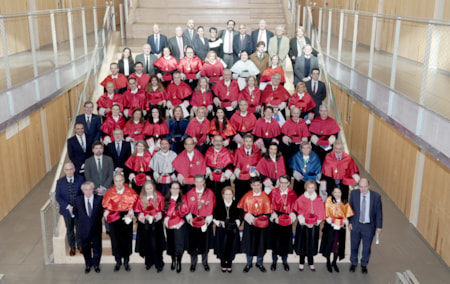
The Law School has marked the feast day of its patron saint, Saint Raymond of Peñafort, with an academic ceremony during which the Faculty’s Plaque was awarded to the European Parliament Office in Spain, the law firm Pérez-Llorca, and the company Ingram Micro.
During the event, Dean Alfonso Martínez-Echevarría highlighted the recent inauguration of the Faculty’s new building, named “Federico Salmón” in honor of its first dean—appointed in 1933—and a three-time government minister, twice as Minister of Justice. He described it as “a place where we will continue to train future jurists and contribute to society.” He also recalled the legacy of Fernando Castiella, Professor of Public International Law and Minister of Foreign Affairs in 1962, whose name designates the auditorium where the ceremony took place; as well as that of Íñigo Cavero Lataillade, Professor of Constitutional Law and three-time minister, who lends his name to the Hearing Room.
During his address, the dean expressed his gratitude to the teaching staff and to the administrative and service personnel for their dedication and commitment to the School, as well as to the institutions, companies, and law firms that contribute each day to the solid legal education students receive. He also congratulated the award-winning students and faculty members.
The Rector, Rosa Visiedo, offered words of appreciation to all those who make the mission of the Law School —and therefore that of the University— possible every day. “To our professors, for their dedication and rigor. To the administrative and service staff, for their quiet yet indispensable professionalism. And especially to our students, the heart of this institution, who give meaning and life to our university spaces,” she said.
Visiedo also thanked the companies and institutions that collaborate with the School, noting that they “enable us to remain close to society and the professional world, facing with preparation and enthusiasm the challenges posed by these times of constant and increasingly rapid change. It is precisely this shared work that allows us to achieve objectives, reach milestones, and overcome challenges.”
The rector went on to highlight the School’s new building, describing it as “a symbol of the growth and consolidation of the School and of the academic programs it offers.” She stressed that the new building is “much more than an infrastructure; it reflects our understanding of education, an education that seeks to unite tradition and innovation, classical foundations and modernity, academic excellence and ethical commitment, legal training and social responsibility.”
To conclude, Visiedo emphasized that the law is not merely a set of rules but an instrument in the service of justice, the common good, and human dignity. “In this new building that houses our Law School, we aim, now and always, to educate rigorous, competent jurists with an international outlook, but above all, deeply human. May it remain for many years a place of study, dialogue, debate, and service. And may the jurists who are trained here learn to look at the world with critical insight, moral strength, and a profound spirit of service,” she affirmed.
The 2025 Waste Collection Fee: A New Tax Increase
Professor of Financial and Tax Law Juan Ignacio Gorospe delivered the keynote lecture “The 2025 Waste Collection Fee: A New Tax Increase,” an analysis of the economic, legal, and constitutional implications of this new tax measure. In his address, he anticipated a period of increased municipal fiscal pressure and emphasized the need to examine how the measure aligns with the principles of legality, equivalence, and tax justice.
The reform, driven by Law 7/2022 on waste and contaminated soils, introduces the requirement that the waste collection fee may not run a deficit and must “enable the implementation” of pay-as-you-throw systems, meaning that each citizen pays according to the amount of waste they actually produce. Gorospe noted that many municipalities continue to apply presumptive systems, based on cadastral value, property size, or water consumption, which do not always reflect true waste generation and therefore diverge from the “polluter pays” principle.
“The mandatory and non-deficit nature of the fee is leading to significant increases in local tax burdens,” Gorospe warned, “without, in all cases, being offset by equivalent reductions in other taxes such as the property tax (IBI).”
Awards and Recognitions
During the Academic Ceremony, the Extraordinary End-of-Degree Awards were presented, along with the Saint Raymond of Peñafort Research Initiation Award (Final Degree Project). Also awarded were the prizes from the Saint Raymond of Peñafort Rhetoric Competition, “The Values of the Transition, 50 Years On”; the CEU–Confilegal Legal Communication Academic Excellence Awards; and the Nueva Mutua Sanitaria Academic Excellence Awards. In addition, recognitions were given to members of the teaching staff and to administrative and service personnel.