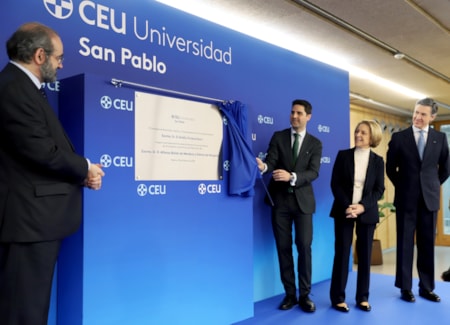
The University has inaugurated the new building of the Faculty of Law, a modern academic space named after the Faculty’s first dean, Federico Salmón (1933), who also served twice as Spain’s Minister of Justice. The building has been designed to strengthen legal education, research, and the institution’s commitment to society. It is conceived as an open centre for the university community and for Madrid society as a whole, promoting justice, legal assistance for the most vulnerable through its Pro Bono Legal Clinic, and the education of jurists who are prepared to face today’s challenges.
The inauguration ceremony was attended by the Regional Minister of Education of the Community of Madrid, Emilio Viciana, accompanied by the Vice Minister for Universities, Research and Science, Mercedes Zarzalejo; the President of the San Pablo CEU University Foundation and Grand Chancellor of the University, Alfonso Bullón de Mendoza; the Rector of CEU USP, Rosa Visiedo; the Director General of CEU, Javier Tello; and the Dean of the Faculty of Law, Alfonso Martínez-Echevarría.
During his address, Viciana congratulated the CEU on the opening of the new building and stated that “as a regional minister, there is no greater satisfaction than seeing Madrid’s universities continue to grow in infrastructure, student numbers, academic programmes, and national and international prestige.” He also pointed out that the CEU “maintains the same spirit it had in 1933: enthusiasm, the pursuit of truth, the dignity of work well done, and a vocation of service to society—values that stem from Christian Humanism.”
The event began with the unveiling of a commemorative plaque at the entrance of the new building and the blessing of the facilities by Father Isidro Molina. In their speeches, academic and institutional authorities highlighted the strategic importance of this new building in consolidating CEU USP as a benchmark in legal education, committed to a comprehensive model that combines academic excellence with ethical values and social responsibility. The ceremony concluded with a guided tour of the new facilities led by the project’s architects.
An innovative building
With a surface area of more than 8,500 square metres, the building currently hosts around 1,200 undergraduate students, 300 postgraduate students, and 150 faculty members. It is a space that brings together architectural, technological, and environmental innovation in the service of future legal professionals. The building consists of three upper floors, a ground floor, a garden level (-1), and three basement levels.
The facilities include 22 classrooms, meeting rooms, offices, a multi-purpose auditorium with seating for 120 people, which is named “Fernando Castiella” in honour of the former Minister of Foreign Affairs and CEU professor, and a mock courtroom that allows students to conduct mock trials and simulations of proceedings before international bodies. The building also houses a pioneering forensic science laboratory in Spain, equipped with advanced technology for the study of disciplines such as forensic ballistics, fingerprint analysis, and questioned document examination.
Spain’s first private School of Law
Founded in 1933, Spain’s oldest private School of Law has developed a creative approach to the teaching of Law and other scientific fields integrated within the Faculty, including Political Science, Criminology and Security, and International Relations. “Our excellence is based on educating jurists and professionals in a comprehensive sense, because society needs responsible professionals with a strong academic foundation and a moral attitude that enables them to contribute to a more just and supportive society,” explained the Dean.
In this regard, Martínez-Echevarría stresses that it is not enough to deliver academic content with excellence: “from the very beginning, students must perceive the practical relevance of the knowledge they are acquiring.” He also highlights the importance of preparing students for a global future, noting that “today, it is impossible to conceive of a top-level professional who is not capable of operating in a plural, increasingly internationalised and rapidly changing context.”
International outlook, teaching innovation and employability
Legal education at CEU USP is based on a bilingual model in legal English, double degree programmes with prestigious universities such as Fordham University (New York), Dublin Business School and Boston University, and more than 90 international mobility agreements across all five continents, allowing academic stays of up to four semesters. This strategy is complemented by specialised training in business, digital and international law, as well as a robust professional placement system supported by more than 12,000 agreements with companies, institutions and law firms, together with the involvement of judges and magistrates in practical training. All of this results in high employability rates and the preparation of globally minded, highly competitive legal professionals.
Artificial Intelligence integrated into Legal Training
The Faculty of Law has incorporated Artificial Intelligence as a regular learning and academic working tool over the past two academic years. The aim of this integration is for students to develop legal skills enhanced but not replaced by AI. “Training focuses on learning how to formulate complex legal problems, refine questions, verify sources, detect errors or biases, and transform results into sound legal reasoning, always keeping the professional judgement of the jurist at the core,” explains Alfonso Martínez-Echevarría.
In this context, the Dean emphasises that the main challenge is not technological, but cultural and methodological: “rethinking how Law is taught and assessed in a context of digital transformation.” He also highlights that this training strengthens the professional competence of future lawyers by enabling deeper analytical and strategic work, while maintaining the principle that legal responsibility remains exclusively human. “We do not train jurists who depend on technology, but professionals capable of leading the transformation of the legal sector with judgement, ethics and academic excellence.”